P50 vs P90 explained for commercial solar projects
P50 is the annual energy your project will meet or beat in half of all years. P90 is the figure it will meet or beat nine years in ten, and it always sits lower. Both come out of the same simulation, and the distance between them is a measure of how much your model doesn't know.
What is the difference between P50 and P90?
The difference is confidence. P50 is the median estimate, and P90 is a conservative estimate that sits below it by the amount of uncertainty in your model.
Start with the annual energy from your energy model. Then put an uncertainty band around it. Weather varies year to year, the irradiance dataset has its own error, and so do shading, soiling, snow, module and inverter behaviour, and degradation. Combine those and you get a distribution of possible years. P50 is the middle of that distribution. P90 is the point where 90% of years land above it. P99 is further out again.
The P-number is an exceedance probability. P90 means a 90% chance that real production in a given year meets or exceeds that value. It does not mean the project will produce 90% of P50.
What do P50 and P90 mean on a solar production report?
On a report, P50 is the number your proposal is built on, and P90 is the number a lender or offtaker will test the project against. They describe the same system on the same weather data, at two levels of confidence.
A P50 that looks high usually means a loss assumption is thin, and a thin loss assumption shows up again as an optimistic P90. Snow and soiling are the usual suspects on C&I work. A flat 2% soiling loss on a Connecticut roof is a guess. Site-specific snow and soiling from the nearest NOAA station, run through the published Townsend and Kimber methods, moved the annual yield on one Connecticut site by about 5% on its own. That swing lands on both numbers.
| Value | Chance a real year meets or beats it | Where it shows up |
|---|---|---|
| P50 | 50% | Proposals, expected revenue, the number customers see |
| P75 | 75% | Some tax equity and internal cases |
| P90 | 90% | Debt sizing, performance guarantees |
| P99 | 99% | Worst-year stress tests |
Why do lenders ask for P90 vs P50?
Lenders size debt on the production they're confident will show up, so they use P90. Developers sell on P50 because that is the expected year.
Debt service has to be covered in a bad year as well as a good one, so the downside case drives the loan. Some lenders also look at a one-year P99 for the worst single year. The developer's job is to keep the P50 honest and the gap to P90 small, because a wide gap means a smaller loan on the same system.
One more thing lenders care about. The model has to be one they recognise. Many financiers still ask for PVsyst, and that's fine. If your financier wants PVsyst, give them PVsyst. The useful question is how fast you can get there from your design tool, and whether the loss assumptions in your design model match the ones in the bankable run.
How do you get P50 to P99 from a design tool?
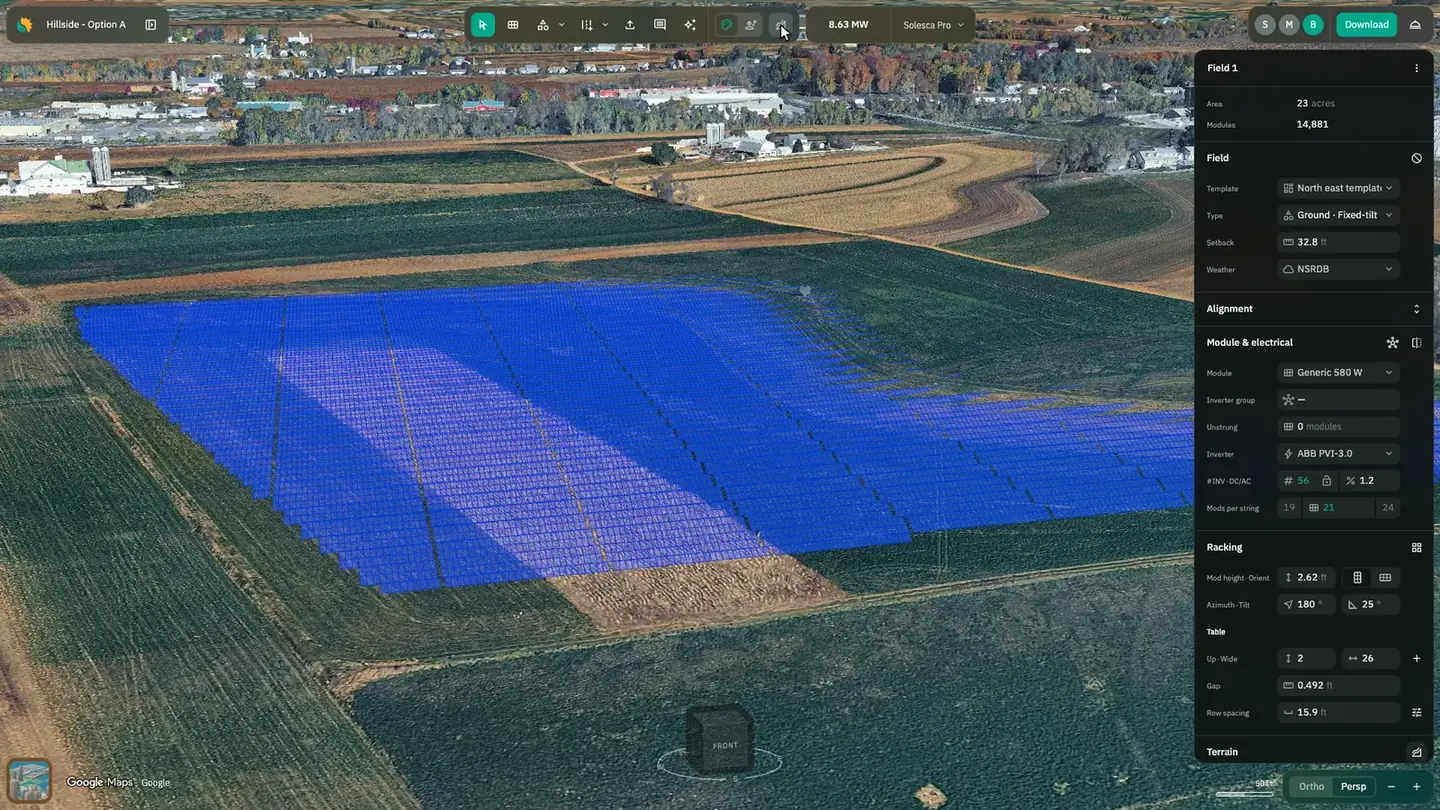
In Solesca every simulation report carries P50 through P99. Solesca simulations validate within 1% of PVsyst, and California Energy Commission staff have recommended the tool for certification under the 2022 Energy Code.
The point of having the full range in the design tool is that the number you quote and the number the bank sees come from the same place. Snow and soiling are pulled from the nearest NOAA ground station and recalculated every time you simulate. Bifacial gain, field AC limits and per-year unavailability are in the model. You can export the 8760 for anyone who wants to rebuild the year themselves.
For the bankable run, two routes are built in. DNV SolarFarmer is integrated, so an independent model the banks already know can run on the same design. And the PVsyst near-shading export produces the .PVC shade scene plus a full project zip with losses, weather and equipment, so you can verify the numbers against PVsyst yourself instead of taking our word for it.
The full energy model workflow is on the energy model page, and how the simulation is validated is on the technology page.
Common questions
Is P90 always lower than P50?
Yes. P90 is the value that real production clears nine years in ten, so it has to sit below the median year. The only way P90 equals P50 is a model with zero uncertainty, which doesn’t exist.
Can P50 and P90 come from the same model?
Yes, and they should. They are two points on the same distribution. If your P50 comes from one tool and your P90 from another with different loss assumptions, the gap between them stops meaning anything.
Which number goes on a performance guarantee?
Most lenders size debt on P90. Guarantee thresholds are negotiated and often land between P50 and P90. Check the term sheet, and make sure the number was produced on the same model the lender reviewed.
Does Solesca report P90?
Yes. Every simulation report carries P50 through P99, with DNV SolarFarmer inside the tool and a PVsyst near-shading export for independent verification.
Compare the P90 to your last bankable run
Run your next project in Solesca and put its P90 beside the one you already have. Book 30 minutes and bring the project.